AI Search
What Is Agentic Browsing and Why Does It Matter for Local Businesses?
June 24, 2026 • 10 min read

Your website is no longer being judged by humans alone
For years, local businesses have been told to focus on three main things when building a website: make it look professional, make it easy for customers to use, and make it easy for Google to understand.
Those things still matter. But there is now another important layer being added to the conversation: whether your website can be understood and used by AI-powered agents. That is where Agentic Browsing comes in.
If you recently tested your website using Google's PageSpeed Insights tool, you may have noticed a newer section called Agentic Browsing beside the familiar categories like Performance, Accessibility, Best Practices, and SEO. For many business owners, this raises an obvious question: what does Agentic Browsing actually mean?
In simple terms, Agentic Browsing looks at whether your website is structured in a way that makes it easier for automated systems, AI assistants, and browser-based agents to understand, navigate, and interact with your site.
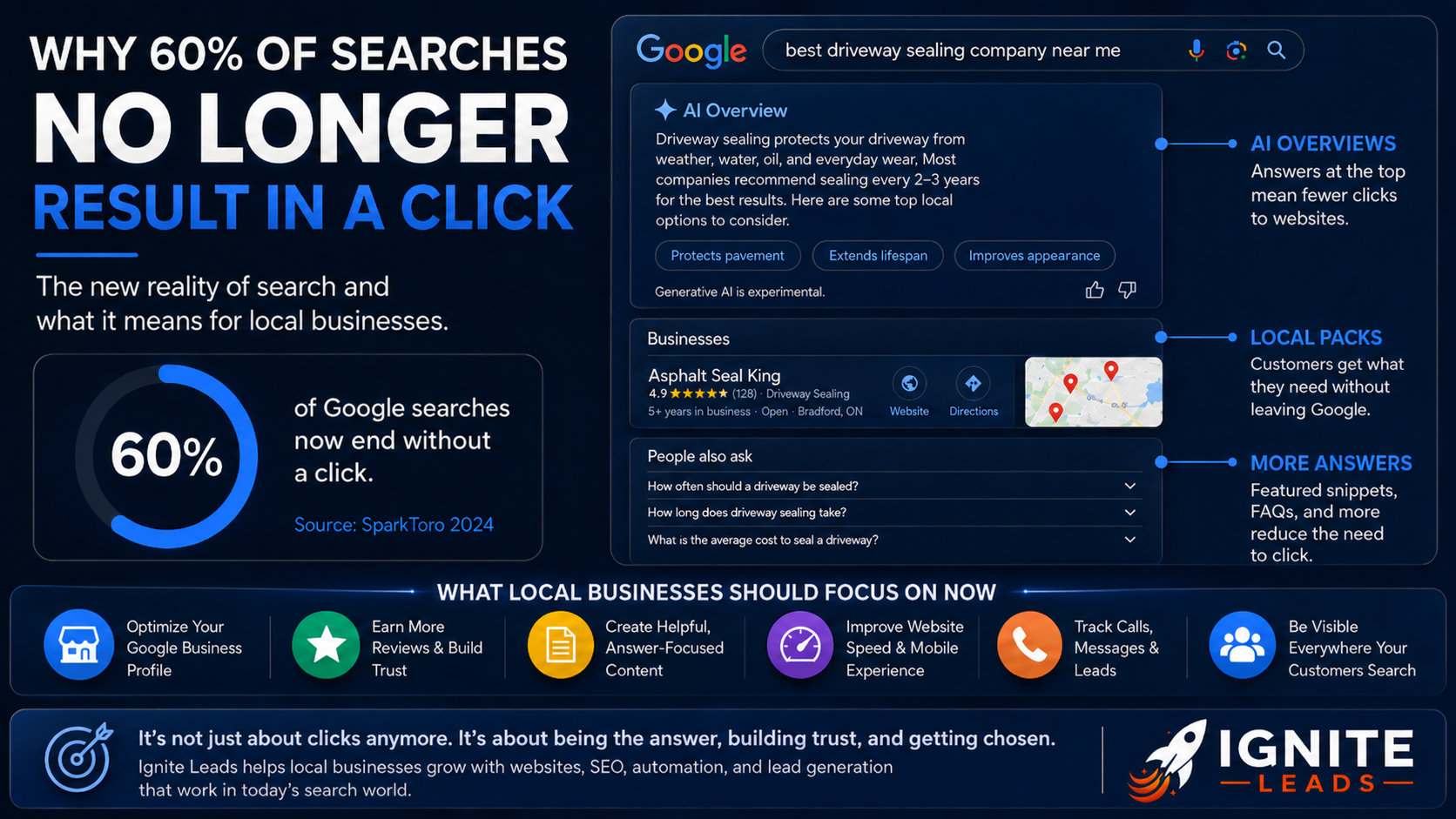
Customers are not only typing keywords into Google anymore. They are asking questions through AI tools, voice assistants, chatbots, browser agents, and AI-powered search experiences. For local businesses, this creates a major opportunity.
What is Agentic Browsing?
Agentic Browsing refers to the ability of AI agents or automated browsing tools to interact with a website in a goal-oriented way. A regular visitor may read your homepage, click your service pages, and fill out a form. An AI agent may try to do something similar — but without browsing like a traditional human user.
It may try to:
- Understand what your business does
- Identify your service areas
- Find your contact information
- Read your main services
- Understand your pricing or offer
- Check whether your website is trustworthy
- Navigate links and buttons
- Interact with forms or page elements
- Summarize your business for a user
- Compare your business against competitors
Traditional SEO is about helping search engines crawl and index your content. Agentic Browsing is about helping AI-driven systems understand and use your website more effectively.
This does not mean your website is being ranked only by AI agents. But it does show where the web is heading. Websites are increasingly being evaluated as structured digital environments that humans, search engines, and AI systems all need to understand.
Why is Google showing Agentic Browsing in PageSpeed Insights?
Google's PageSpeed Insights tool uses Lighthouse to audit different aspects of a webpage. Traditionally, business owners focused on four categories: Performance, Accessibility, Best Practices, and SEO. Now, some reports also include Agentic Browsing.
Unlike the Performance score, which is shown as a number out of 100, Agentic Browsing may appear as a ratio, such as 3/3. That means the tested page passed the applicable Agentic Browsing checks available in that report.
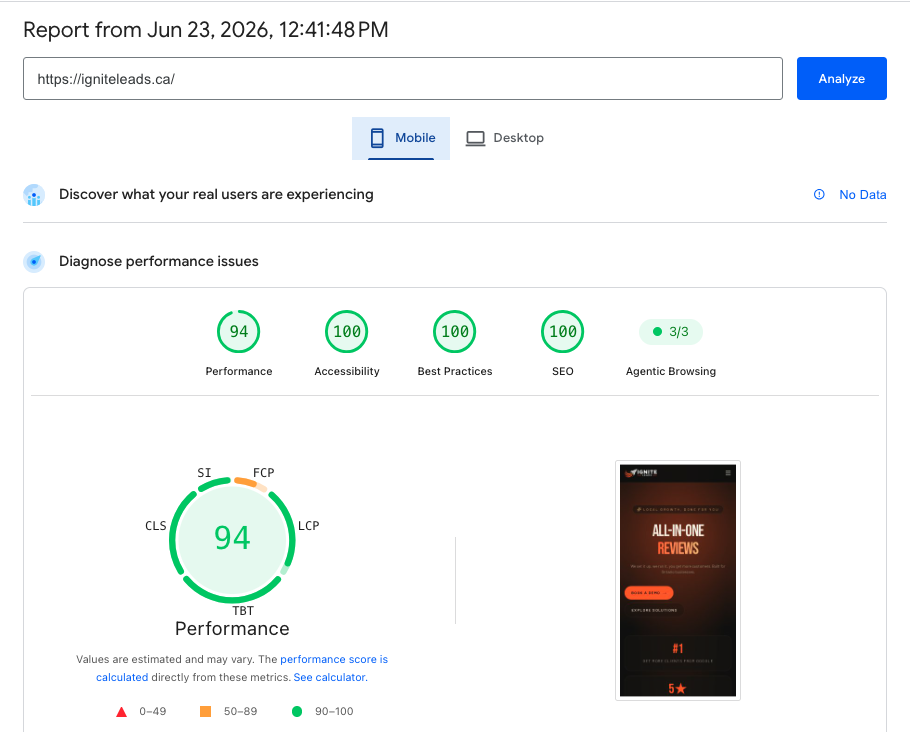
For example, in our Ignite Leads PageSpeed report, the site showed:
- Performance: 94
- Accessibility: 100
- Best Practices: 100
- SEO: 100
- Agentic Browsing: 3/3
That is a strong technical result — the site is fast, search-friendly, and structured to support machine interaction. (We broke down each of those categories in this post on what PageSpeed scores really mean.)
What does Agentic Browsing measure?
Agentic Browsing is still an emerging area, but the goal is straightforward: it looks at whether your website is built in a way that allows machine-based browsing systems to access, understand, and interact with it reliably.
- Clear page structure
- Accessible navigation
- Stable page layout
- Machine-readable information
- Well-labelled buttons and links
- Helpful content organization
- Good technical foundations
- Content that is easy to interpret
This is closely connected to other areas of website quality. Poor accessibility usually means buttons, links, and headings are not properly labelled, which also makes a site harder for AI agents to understand. Layout instability makes a site harder for automated systems to interact with. Weak SEO structure means important content is missing or buried.
Agentic Browsing is not a separate, isolated score. It is connected to the overall quality of your website.
Why local businesses should care about Agentic Browsing
For a local business, your website has one main job: help the right people find you, trust you, and contact you. Agentic Browsing matters because more of that journey may soon involve AI-powered tools.
A potential customer might ask an AI assistant:
- “Find me a driveway sealing company in Bradford.”
- “Who offers piano lessons in Aurora?”
- “What is the best bin rental company near Newmarket?”
- “Find a local marketing agency that builds affordable websites.”
- “Compare roofers near me and tell me who looks trustworthy.”
AI-powered tools need clear signals to understand what your business does, where you operate, what services you offer, how to contact you, and whether your website appears useful and trustworthy. If your site is confusing, slow, poorly structured, or missing important information, it may be harder for these systems to interpret your business correctly — even if your business is great.
Agentic Browsing and local SEO are connected
Agentic Browsing is not a replacement for SEO — it is connected to it. Local SEO is still about helping your business appear when people search for your services in your area: optimized service pages, location-specific content, strong title tags, Google Business Profile, reviews, local backlinks, consistent NAP, and fast mobile performance.
Agentic Browsing adds another layer. It encourages businesses to think about whether their website is structured clearly enough for AI-driven systems to interpret. A clear website helps everyone — humans and machines. The best approach is not to “optimize for bots” instead of humans. It is to build a site that is clean, fast, helpful, accessible, and structured so it works for both.
The shift from search engines to answer engines
In the past, a customer would search on Google, scan a list of websites, click a few links, and decide who to contact. Now, AI tools can summarize information, compare businesses, and sometimes guide users toward a decision without them visiting as many websites manually.
This does not mean websites are becoming less important. It means websites need to be better. Your website may become the source that AI tools use to understand your business. If the information is thin, unclear, or poorly structured, your business is harder to recommend.
What a local business website should make clear
A strong local business website should quickly answer the most important questions a potential customer has:
- Who are you?
- What do you do?
- Where do you provide your services?
- Who do you help?
- Why should someone choose you?
- How can someone contact you?
- What should they do next?
Practically, that means a strong homepage headline, clear service pages, city or service area information, a clickable phone number, a simple contact form, trust signals and reviews, FAQs, fast-loading pages, mobile-friendly design, proper heading structure, and clear calls-to-action. These elements help human visitors — and they help Google, AI search tools, and agentic browsing systems understand the purpose of the website.
Why performance, accessibility, and best practices still matter
Agentic Browsing does not replace website speed. A slow site loses visitors before the page loads, makes crawling harder for search engines, and creates friction for automated tools. Core Web Vitals still apply.
Accessibility helps more than people using screen readers. Readable text, clear contrast, proper headings, descriptive links, labelled buttons, usable forms, and logical navigation also make your site easier for machines to interpret. The Best Practices score reflects whether your site follows modern technical standards — AI agents and automated tools depend on websites behaving predictably.
Why SEO still matters in an AI-driven world
Some people believe AI will replace SEO. That is the wrong way to look at it. AI-powered systems still need information to work from — clear content, structured pages, helpful answers, and reliable business details. A strong SEO foundation helps your website communicate clearly: page titles, meta descriptions, headings, service content, location pages, internal links, schema markup, helpful FAQs, and consistent business details.
Agentic Browsing is not about chasing a vanity score
The real value of a strong Agentic Browsing result is what it tells you about your website — that it is better prepared for the next stage of the web, where AI tools and automated agents play a bigger role in how customers find information. The goal is not a green score. The goal is a better website: faster, easier to use, easier to understand, more accessible, more trustworthy, and more likely to turn visitors into leads.
How Ignite Leads helps local businesses prepare
Most local business websites were not built with Agentic Browsing in mind. Many were built years ago with outdated themes, bloated plugins, slow hosting, and weak mobile layouts. That may have been enough in the past — but today, your website also needs to support mobile users, Google search, local SEO, paid traffic, AI-powered discovery, conversion tracking, and lead capture.
At Ignite Leads, our $99/month website package is designed to give local businesses a clean, modern, technically sound foundation: fast mobile loading, clean page structure, strong technical SEO, clear service messaging, accessible design, reliable best practices, simple calls-to-action, and local business visibility built in.
The PageSpeed report for IgniteLeads.ca — Performance 94, Accessibility 100, Best Practices 100, SEO 100, Agentic Browsing 3/3 — is the type of foundation we aim to provide for clients. Every business is different and results can vary, but the goal is the same: websites that are fast, clear, search-friendly, and ready for the way customers are searching now.
Final thoughts: Agentic Browsing is about being ready for what comes next
Agentic Browsing may sound technical, but the idea is simple. Your website should be easy to understand and easy to use — not only for people, but also for the tools people use to find answers.
A strong website today should be built for humans, structured for Google, ready for AI-powered discovery, and designed to turn visitors into leads. That is exactly what we focus on at Ignite Leads. Book a quick demo and we'll show you what a fast, AI-ready local business website looks like.
Allan Heath
Founder of Ignite Leads. Helps local businesses grow through SEO, lead generation, and marketing automation — simplifying the playbook so owners can focus on the work.