Local SEO
Why 60% of Searches No Longer Result in a Click, and What It Means for Local Businesses
June 25, 2026 • 12 min read
Google search is changing faster than most business owners realize
For years, the goal of SEO was simple. Get your business on page one of Google. Get more people to click your website. Turn that traffic into leads.
That still matters, but the way people interact with search engines is changing. Today, a growing number of searches no longer result in someone clicking a website at all. These are called zero-click searches.
A zero-click search happens when someone searches for something on Google and gets the answer they need directly on the results page. They do not click through to a website because Google has already shown them enough information.
This can happen through:
- AI Overviews
- Featured snippets
- Google Business Profile results
- Map packs
- People Also Ask sections
- Knowledge panels
- Local service results
- Shopping results
- Instant answers
- Weather, calculator, sports, and definition results
Now, with AI tools like Gemini and AI Overviews becoming more visible inside search results, this trend is becoming even more important.
For local businesses, this changes the game. It is no longer enough to ask, “How do we get more clicks from Google?” The better question is: how do we make sure our business is visible, trusted, and chosen even when people do not click?
What is a zero-click search?
A zero-click search is any search where the user gets the information they need without clicking on an organic website result. For example, someone might search:
- “What time does a local store close?”
- “Best pizza near me”
- “How much does driveway sealing cost?”
- “Emergency plumber near me”
- “Piano lessons for kids in Aurora”
- “Bin rental prices in Newmarket”
In the past, the user may have clicked several websites to compare answers. Today, Google may show enough information directly on the search results page — business hours, reviews, service descriptions, directions, phone numbers, map listings, summaries, FAQs, and AI-generated answers — before they ever visit a website.
That means the search still happened. The customer still had intent. But the website visit may not happen. This is why business owners need to understand the difference between search visibility and website traffic.
Why are more searches ending without a click?
The biggest reason is that search engines are trying to answer questions faster. Google has spent years adding features that give users information directly on the results page — featured snippets, maps, business profiles, review stars, People Also Ask boxes, and knowledge panels.
Now, AI Overviews are adding another layer. Instead of simply showing links, Google can summarize information from multiple sources and present an answer directly at the top of the page. This makes search more convenient for users, but it also means fewer people may need to visit the websites that provided the original information.
For local businesses, this creates both a challenge and an opportunity. The challenge is that fewer people may click through to your website for simple questions. The opportunity is that businesses with strong, clear, well-structured content may still appear in the places where customers are making decisions.
How Gemini and AI Overviews are changing search
Google has been integrating AI more deeply into search through AI Overviews and Gemini-powered experiences. Instead of only returning a list of blue links, Google can now generate a summarized answer.
For example, someone could search: “What should I look for when hiring a local SEO company?” Instead of just showing ten websites, Google may display an AI-generated summary that explains what to look for, what questions to ask, and what factors matter. That answer may include links, but the user may not click them if the summary satisfies their question.
That means your website content needs to do more than simply exist. It needs to be clear, helpful, specific, and structured in a way that search engines and AI systems can understand. We covered this shift in more depth in our guide to Agentic Browsing.
Why this matters for local businesses
Local businesses depend on visibility. Whether you are a contractor, dentist, music academy, cannabis store, painter, landscaper, bin rental company, restaurant, or local service provider, customers often find you through search. But if search results are changing, your strategy needs to change too.
Today, a strong local SEO strategy needs to focus on:
- Being visible in traditional organic search
- Showing up in the local map pack
- Having a strong Google Business Profile
- Earning strong customer reviews
- Publishing helpful website content
- Answering common customer questions
- Building trust before the click
- Creating content that can be used in AI-generated answers
- Making contact options easy to find
- Tracking phone calls, form fills, bookings, and messages, not just website visits
A business owner may look at their website analytics and think traffic is down. But that does not always mean demand is down. It may mean more customers are finding answers directly in Google before deciding what to do next. That is why tracking only website visits can be misleading.
Search visibility now happens before the click
One of the biggest mistakes local businesses make is assuming the website visit is the beginning of the customer journey. It is not. The customer journey often starts on the search results page.
Before someone clicks your website, they may already see your business name, your review rating, your number of reviews, your business hours, your service category, your photos, your location, your Google Business Profile description, your FAQs, your map listing, your competitors, your website title, your meta description, and your AI-generated summary mention.
That means customers are forming opinions before they ever visit your website. If your business looks incomplete, outdated, poorly reviewed, or unclear in the search results, you may lose the lead without ever seeing a website visit.
The click is not the only conversion anymore
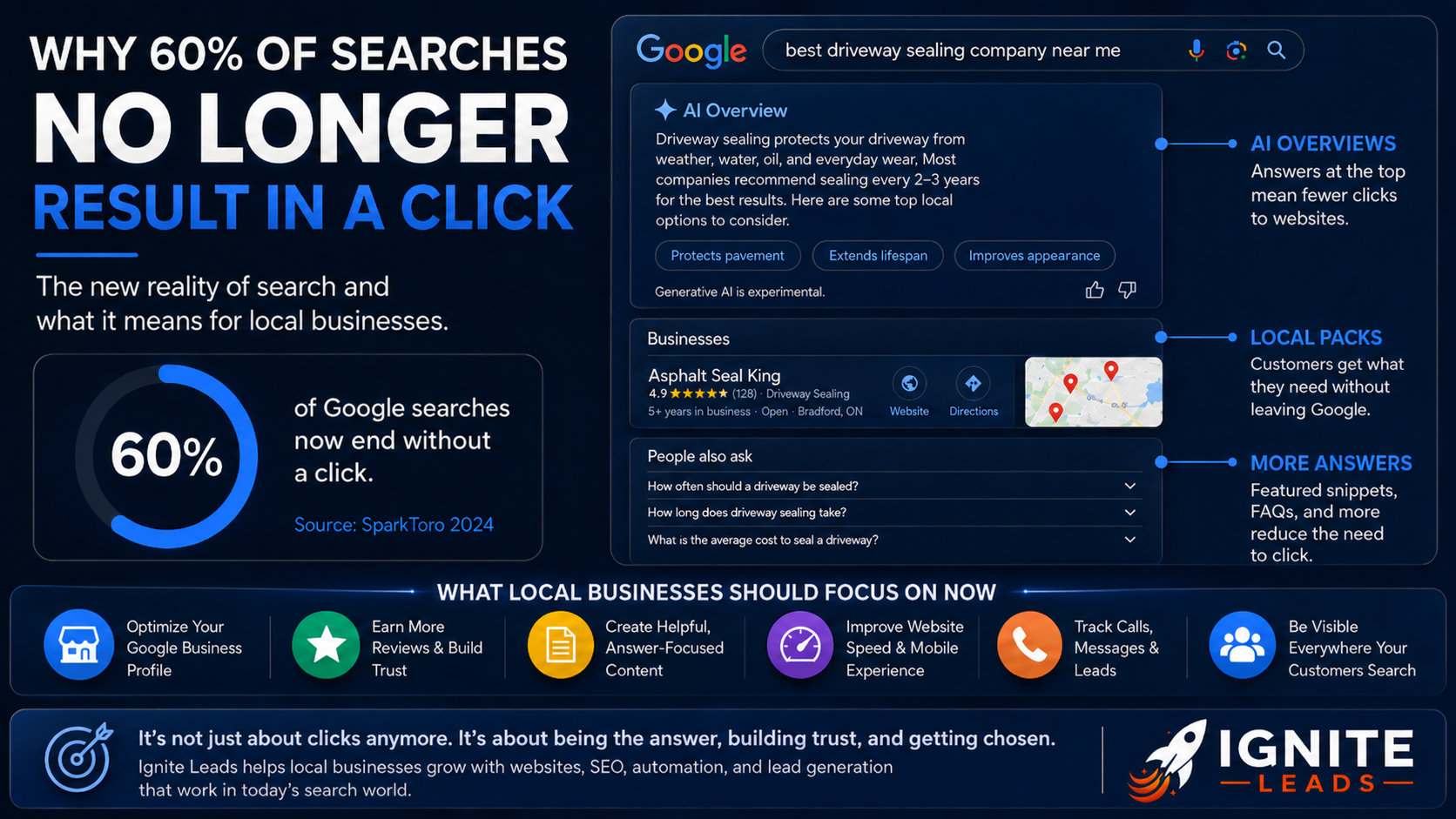
When people hear that nearly 60% of searches end without a click, they often assume that means businesses lose. That is not always true. For local businesses, a no-click search can still lead to action. A customer may:
- Call directly from Google
- Click for directions
- Read reviews and choose you later
- Save your business
- View your photos
- Send a message
- Book an appointment
- Visit your location
- Search your brand name later
- Ask an AI tool to compare you with competitors
The problem is that many businesses are not tracking these actions properly. They only look at website traffic. But a local business can generate leads from search without every lead showing up as a website visit. A connected CRM and automation system helps you capture and track those leads end-to-end.
What this means for SEO
SEO is not dead. SEO is changing. The goal is no longer just to rank and get clicks. The goal is to become one of the most useful, trusted, and visible answers in your market. That means your website content should answer the real questions your customers are asking:
- How much does this service cost?
- What areas do you serve?
- How does your process work?
- How long does the service take?
- What makes your business different?
- What should customers know before booking?
- What problems do you solve?
- What are the most common mistakes customers should avoid?
- Why should someone choose a local provider?
These questions matter because they match how people search today. They also match how AI-powered search tools summarize information. Generic content will struggle. Thin service pages will struggle. Websites that only say “we are the best” without providing useful information will struggle. Helpful content wins.
Why Google Business Profile is more important than ever
For local businesses, Google Business Profile is one of the most important parts of a zero-click search strategy. Many local searches never need a website click because the Google Business Profile provides enough information for the customer to act — phone number, hours, address, service area, photos, reviews, services, posts, products, FAQs, booking link, website link, and directions.
If your Google Business Profile is incomplete, you are losing visibility where local decisions are happening — especially for “near me”, emergency, restaurant, appointment, home service, retail, and professional service searches. Earning more reviews is one of the fastest ways to strengthen it, and that is exactly what our Review Ninjas service is built for.
Your website still matters, even when people do not click
Some business owners hear about zero-click search and assume websites are becoming less important. That is not true. Your website still matters. In fact, your website may matter more than ever.
Why? Because your website helps feed the information ecosystem around your business. Google, AI tools, and potential customers all look for signals that help them understand who you are, what you do, where you work, and why you are credible. Your website supports organic rankings, local SEO, AI search visibility, Google Business Profile strength, paid ad landing pages, lead capture, trust building, service education, conversion tracking, retargeting, and brand authority.
What kind of website content performs better in a zero-click world?
In a zero-click world, vague website content is not enough. Your website should clearly answer specific customer questions. Strong content includes:
- Detailed service pages
- Location-specific landing pages
- FAQ sections
- Helpful blog articles
- Pricing guidance where appropriate
- Comparison content
- Process explanations
- Before-and-after examples
- Customer pain points
- Trust signals
- Reviews and testimonials
- Clear calls-to-action
For example, a local driveway sealing company should not only have a page that says “We offer driveway sealing.” It should answer how often a driveway should be sealed, what areas they service, what type of sealant they use, how long the process takes, what homeowners should do before they arrive, how much driveway sealing usually costs, and what makes their service different.
The rise of answer engine optimization
As search changes, many marketers are starting to talk about answer engine optimization, often called AEO. AEO means optimizing your content so it can be understood and used by answer-based systems, including AI search tools, voice assistants, and search result summaries. Traditional SEO focuses on rankings. AEO focuses on answers. For local businesses, both matter.
Your website should still be optimized for keywords like local SEO Barrie, local SEO Newmarket, local SEO Aurora, and local SEO Vaughan. But your content should also answer conversational questions like “What is the best way for a local business to get more leads?” and “Why is my business not showing up on Google?” — because that is how people search now.
Why brand visibility matters more now
When fewer searches result in clicks, your brand needs to be recognizable before the click. That means your business should appear consistently across Google Business Profile, your website, social media profiles, review platforms, local directories, blog content, map listings, search results, AI-generated summaries, and industry websites.
The more consistent your brand is, the easier it is for people and search systems to trust your business. Local businesses often underestimate how important consistency is. But when Google and AI systems are trying to understand your business, inconsistent information can create confusion. Confusion hurts visibility. Clarity supports visibility.
What local businesses should do now
The rise of zero-click search does not mean you should panic. It means you should adapt. Here are the areas local businesses should focus on now.
1. Strengthen your Google Business Profile. Make sure your profile is complete, accurate, and active. Add services, photos, FAQs, updates, business descriptions, service areas, and strong calls-to-action.
2. Build better service pages. Every core service should have its own dedicated page that clearly explains what the service is, who it is for, where it is offered, and why someone should choose your business.
3. Create helpful FAQ content. FAQ content is powerful because it matches how people search. It also gives AI and search engines clearer answers to work with.
4. Focus on local content. Mention the cities, towns, neighborhoods, and service areas that matter to your customers. Generic content is less useful than specific local content.
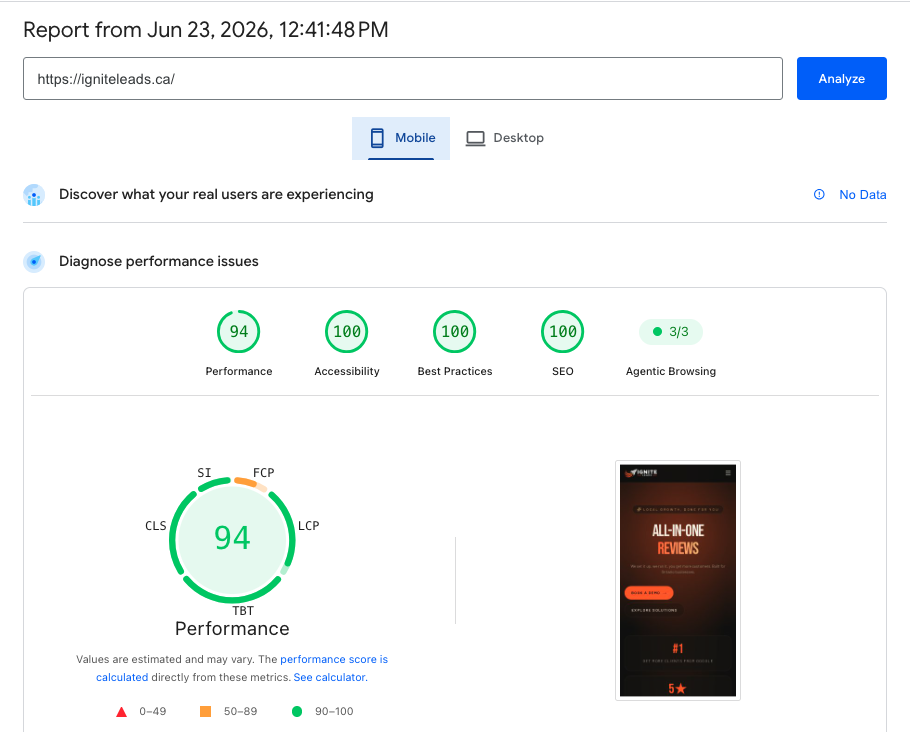
5. Improve website speed and mobile experience. Even in a zero-click world, people who do click expect your site to load quickly. We broke down what those scores mean in our PageSpeed guide.
6. Track more than website traffic. Measure calls, form submissions, bookings, direction requests, Google Business Profile actions, and actual leads. Traffic alone does not tell the full story.
7. Build trust everywhere. Reviews, testimonials, photos, case studies, and clear service information all help people choose you faster. Trust matters before and after the click.
Why this connects to Ignite Leads’ $99/month website package
At Ignite Leads, we believe local businesses need websites that are built for the way search works now, not the way it worked ten years ago. Our $99/month website package is designed to give local businesses a clean, fast, professional, and search-friendly website foundation — mobile-friendly, fast-loading, easy to understand, structured for search engines, clear about services and service areas, built with strong calls-to-action, and ready for AI-powered search experiences.
A modern website should not just look good. It should help your business show up, get understood, and convert attention into leads. As more searches end without a click, your website and Google Business Profile need to work together. Your website provides the depth. Your Google Business Profile provides visibility at the decision point. Your content provides answers. Your reviews provide trust. Your calls-to-action turn interest into leads.
The future of search is not just about clicks
Clicks still matter. Website traffic still matters. SEO still matters. But they are no longer the whole story. The future of search is about visibility, trust, answers, and action.
A customer may discover your business through a Google map result. They may read an AI-generated summary. They may see your reviews. They may compare you without clicking. They may call directly from your profile. They may visit your website later. They may ask an AI assistant for a recommendation. The path is no longer linear. That means your online presence needs to be stronger across every touchpoint.
Final thoughts: zero-click search is a warning and an opportunity
Nearly 60% of Google searches ending without a click is not just a marketing statistic. It is a sign that customer behavior has changed. People want faster answers. Google is providing more information directly inside search results. AI tools like Gemini and AI Overviews are making search more conversational and answer-focused.
For local businesses, this means your strategy needs to evolve. You need to stop thinking only about rankings and clicks. You need to think about visibility, trust, helpful content, local authority, and lead generation across the full search experience. The businesses that adapt will have an advantage. They will show up more clearly. They will answer customer questions better. They will build trust before the click. And when customers are ready to act, they will be easier to choose.
At Ignite Leads, our goal is to help local businesses build that foundation with affordable websites, SEO, automation, and lead generation systems that are ready for where search is heading next. Because your website should not just get clicks — it should help your business get chosen. Book a quick demo and we'll show you how.
Allan Heath
Founder of Ignite Leads. Helps local businesses grow through SEO, lead generation, and marketing automation — simplifying the playbook so owners can focus on the work.