Article
Lead Response Guide for More Booked Service Jobs
September 16, 2026 • 7 min read
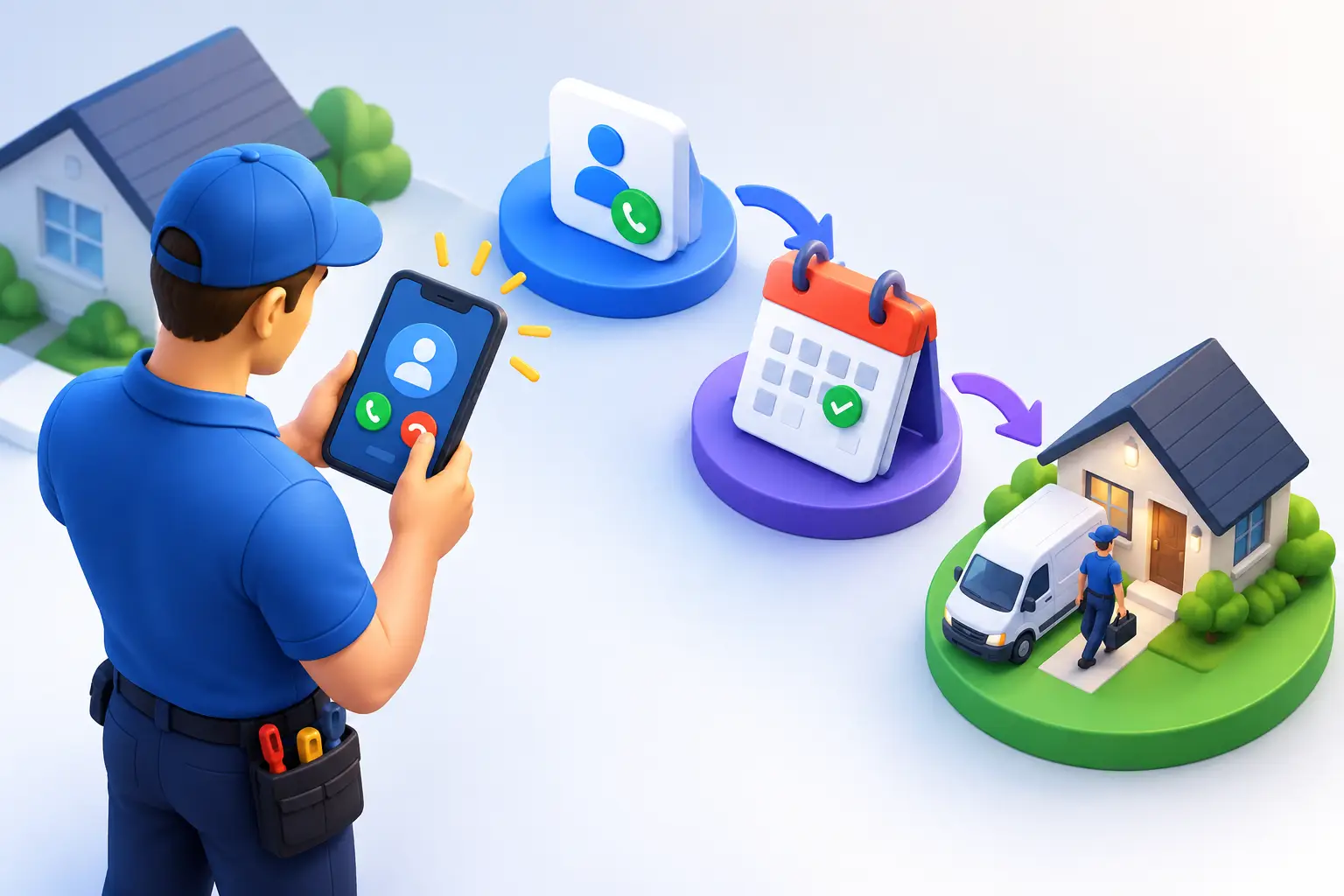
A homeowner with a leaking pipe is not researching your company for an hour. They are looking for someone who can help now. The same is true for a driver needing a repair, a parent booking a tutor, or a client searching for a spa appointment. This lead response guide is built around that reality: the business that responds first, clearly, and professionally is usually the business that gets the booking.
Most local businesses do not have a lead problem. They have a response problem. Calls go to voicemail during busy hours. Website forms sit in an inbox. Facebook messages are answered after dinner. By the time someone replies, the prospect has already called two competitors and booked with one of them.
The fix is not asking your team to work harder. It is building a system that catches every enquiry, responds immediately, and gives a real person the information needed to close the job.
Why speed-to-lead changes local sales
A new lead has the highest intent at the moment they call, submit a form, or start a chat. They have a problem, they are actively looking, and they are willing to speak with a provider. That window closes quickly when the customer gets no confirmation that anyone is available.
Fast response does more than make your business look organized. It reduces uncertainty. A simple, immediate message such as, “Thanks for contacting us. We have your request and will call you shortly,” tells the prospect they do not need to keep searching.
Speed alone will not save a weak sales process. If your reply is vague, your pricing is confusing, or no one follows through, leads will still disappear. But slow response guarantees lost opportunities, especially in competitive markets such as Barrie, Newmarket, Aurora, and Vaughan where customers can find several service providers in seconds.
Lead response guide: set a clear response standard
Every source of leads should have an owner, a response target, and a backup. Without those three things, responsibility becomes vague and leads get missed.
Set standards that fit the channel and your operating hours. Phone calls should be answered live whenever possible. If a call cannot be answered, return it quickly and send an automatic text confirming that you received the call. Website forms and chat enquiries should receive an instant acknowledgement, followed by a human response as soon as a team member is available.
A practical baseline looks like this:
- Answer live calls during business hours or return missed calls within five minutes.
- Send an instant text or email acknowledgement after every form submission.
- Respond to social messages and web chat within 10 minutes during operating hours.
- Follow up on unresponsive new leads more than once, using a defined schedule.
The exact timing depends on your business. An emergency restoration company needs near-instant response. A coaching practice can often work with a slightly longer window. What does not change is the need for consistency. If your staff cannot meet the standard manually, automation needs to cover the gap.
Stop treating each channel like a separate business
Many owners still manage calls in one place, website forms in another, Facebook messages on a personal phone, and email leads in a shared inbox. This creates blind spots. It also makes it impossible to know which marketing is producing real revenue.
Centralize leads in one CRM. Every call, form, chat, and campaign response should create or update a contact record. The record should show the source, the service requested, the assigned staff member, the communication history, and the next action.
This is where an integrated system earns its keep. Rather than checking five apps and hoping someone responded, your team works from one queue. Automation can acknowledge the lead, notify the right person, trigger follow-up, and flag conversations that have gone cold. Managers can see whether leads are being handled instead of relying on verbal assurances.
For service businesses, this also prevents a common frustration: spending money on local SEO, ads, or outreach only to lose the resulting enquiries because nobody saw them in time.
Use automation for the first minute, not the whole relationship
Automation should remove delay, not make customers feel ignored. The first response needs to be immediate and useful. After that, the conversation should move toward qualification and booking.
For example, a missed-call text can say: “Thanks for calling [Business Name]. We are assisting another customer. What service do you need, and what is the best time to call you back?” A website enquiry can receive: “Thanks, we received your request for [service]. A team member will contact you shortly. If the issue is urgent, reply with your preferred callback time.”
These messages work because they confirm receipt and ask for a simple next step. They do not pretend that a person has reviewed every detail when they have not.
AI chat and voice reception can help outside business hours or when staff are tied up. It can answer common questions, collect job details, check service areas, and route urgent requests. The trade-off is that automation must be trained on accurate business information. If it gives unreliable availability, incorrect prices, or generic answers to a specific problem, it can create more friction than it removes.
Keep the handoff clear. When a lead needs a quote, diagnosis, sensitive discussion, or appointment confirmation, make it easy for a qualified team member to take over.
Make the first human conversation count
The purpose of the first conversation is not to explain everything your company does. It is to understand the need, establish confidence, and move the prospect to a concrete next step.
Start by confirming the request: “I understand you are looking for a garage door repair in Vaughan. Is the door stuck open, closed, or making noise?” Then gather only the information needed to qualify the job. Ask about location, timing, service type, urgency, and any details that affect scheduling or pricing.
Next, give the prospect a clear path forward. That might be a booked estimate, a service window, a consultation, or a request for photos. Avoid ending with, “Let us know if you have questions.” That puts the work back on the customer and leaves no commitment.
Instead, use language that creates movement: “We have an opening tomorrow between 10 and 12. Would that work?” or “I can book your assessment for Tuesday at 4:30 or Thursday at 11. Which is better?” Specific options convert better than open-ended requests because they make the decision easier.
Follow up without becoming a nuisance
Not every lead books on the first call. Some are comparing options, waiting for a spouse, dealing with work schedules, or simply distracted. A structured follow-up process gives good leads another chance to convert.
For high-intent enquiries, follow up promptly after the initial conversation or quote. A short text is often effective because customers can respond when convenient: “Hi Sam, checking whether you would like us to hold the Thursday appointment for you. Reply YES and we will confirm it.”
If there is no reply, use a mix of calls, texts, and email based on the customer’s preferred channel. Keep each message useful. Remind them of the requested service, answer a likely question, or offer a clear booking option. Three to five well-timed follow-ups are usually more productive than one message and silence.
There is a line. Stop chasing leads that ask not to be contacted, and do not send repeated messages with no added value. Your goal is to make booking easy, not to pressure someone into a decision.
Measure the gaps that cost you jobs
A lead response system needs reporting, not guesswork. Review a small set of numbers every week: total new leads, percentage contacted, average first-response time, appointments booked, quotes sent, closed jobs, and revenue by lead source.
Then look for the operational leak. If plenty of leads come in but few are contacted, the issue is coverage or notifications. If contact rates are high but bookings are low, the issue may be qualification, scheduling, pricing, or sales conversations. If quotes are sent but not accepted, review the follow-up process before assuming you need more leads.
This is the advantage of treating lead handling as part of your marketing system. Website traffic, Google visibility, reviews, outreach, and follow-up should work together toward one result: more qualified customers booked into your calendar.
A missed lead is rarely just a missed message. It is a customer who was ready to choose a provider and did not get a reason to choose yours. Build the response process before you buy more traffic, and every marketing dollar has a better chance of turning into real work.
Allan Heath
Founder of Ignite Leads. Helps local businesses grow through SEO, lead generation, and marketing automation — simplifying the playbook so owners can focus on the work.