Article
Local Business Growth Guide That Gets More Calls
August 19, 2026 • 7 min read

A local customer finds your business, checks your Google profile, visits your website, and sends an enquiry. If nobody responds for 20 minutes, they call the next company. That is why this local business growth guide is not about collecting more marketing tools. It is about building one system that captures demand, responds immediately, and turns interest into booked work.
For service businesses, growth rarely comes from one big campaign. It comes from fixing the points where revenue leaks out: poor visibility, an outdated website, thin reviews, missed calls, slow follow-up, and no clear process for tracking leads. Get those fundamentals working together and growth becomes far more predictable.
Start With the Customer Journey, Not the Channels
Most owners look at marketing in pieces. They pay someone for a website, try social media, run an ad, then ask customers for reviews when they remember. The result is activity without control.
Your customer sees one business, not five separate tools. They need to find you, trust you, get an answer, and book quickly. Every part of your marketing should support that sequence.
For a garage in Vaughan, that may mean showing up when someone searches for brake repair, displaying recent reviews, making it easy to call, and sending an instant text reply if the shop is busy. For a home service company in Barrie, it may mean turning an after-hours web enquiry into a scheduled estimate before a competitor replies the next morning.
The channel matters, but the handoff matters more. A strong ranking does not help if visitors cannot quickly understand what you do. A good ad does not help if calls go unanswered. A polished website does not help if leads sit in an inbox for two days.
Build Visibility Where Buying Intent Is Highest
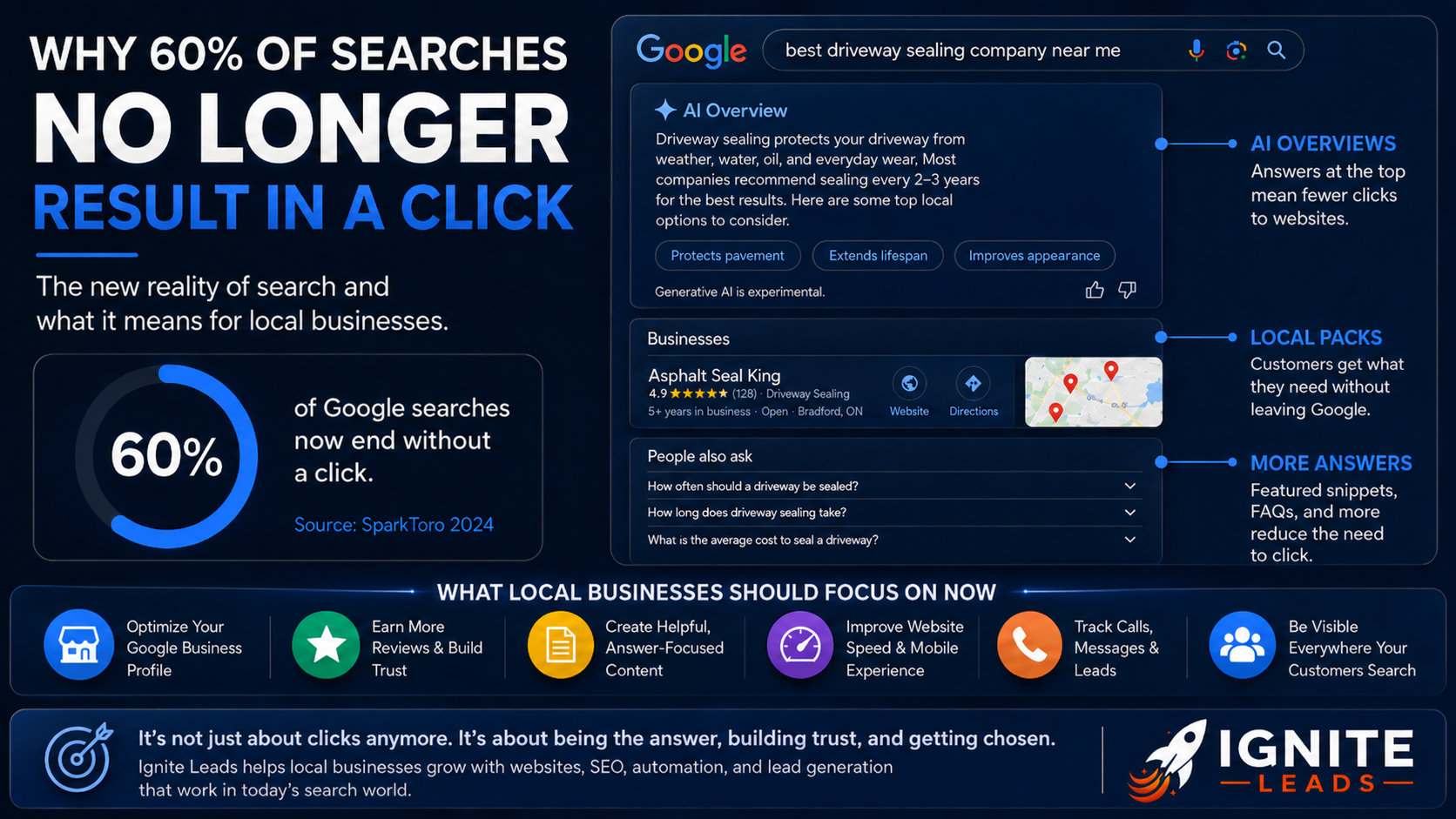
Local growth starts where customers already have a problem and are looking for a provider. For most service businesses, that means Google Search and Google Maps.
Your Google Business Profile should be complete, accurate, and actively managed. Choose the right primary category, define service areas realistically, add current photos, publish services, answer questions, and keep hours updated. These are not cosmetic tasks. They help Google understand when your business is relevant and help customers decide whether to contact you.
Your website needs to reinforce that relevance. Each core service should have a focused page that explains who it is for, what is included, the areas you serve, and how to get started. A page trying to sell every service to every visitor usually converts poorly.
Avoid the “More Pages” Trap
More location pages are not automatically better. If you serve Newmarket, Aurora, Barrie, and Vaughan, create useful pages only where you can provide real local detail and deliver the service. Thin pages with swapped city names add little value for customers and can create a weak site overall.
The goal is straightforward: when a local prospect searches for the service you provide, your business should appear credible, relevant, and easy to contact. Rankings are valuable, but qualified calls and booked appointments are the result that counts.
Turn Your Website Into a Booking Tool
A local business website is not a digital brochure. Its job is to move a visitor to the next step.
Within seconds, a visitor should know what you do, where you work, and why they should choose you. Put your primary service and location context near the top. Use clear calls to action such as “Request an Estimate,” “Book an Appointment,” or “Call Now.” Do not make people hunt through a menu to find out how to contact you.
Trust needs to appear before the form. Include real reviews, before-and-after work where appropriate, certifications, warranty information, team details, and plain explanations of your process. A spa, coach, contractor, or auto shop will use different proof, but every service business needs proof.
Keep forms short. Name, phone number, email, service needed, and a brief message are usually enough. Longer forms can help qualify high-value projects, but they also lower the number of enquiries. The right balance depends on your sales process. If you offer custom renovations, more detail may save time. If you provide emergency repairs, speed matters more than detail.
Speed to Lead Is a Competitive Advantage
Many local businesses spend money to create leads, then lose them because nobody responds quickly. This is one of the easiest growth problems to fix.
When a prospect submits a form, calls after hours, or sends a chat message, they should receive an immediate acknowledgement. A simple message confirming that the request was received and explaining when they will hear back reduces drop-off. Better still, automated chat or AI reception can answer common questions, collect key information, and offer booking options while your team is on a job or serving another customer.
Automation should support your staff, not impersonate them badly. Customers still expect a human when the question is complex, urgent, or sensitive. Set clear handoff rules. An AI receptionist can handle basic availability, service areas, and appointment intake. A trained team member should handle pricing exceptions, technical assessments, complaints, and high-value sales conversations.
Track response time as seriously as you track lead volume. If one source produces fewer leads but they are answered in under five minutes and book at a higher rate, it may be more valuable than a larger source with poor follow-up.
Make Reviews Part of Operations
Reviews influence both visibility and conversion. A prospect comparing two similar providers will often choose the business with more recent, detailed feedback and a professional response to concerns.
The mistake is asking for reviews only when business is slow. Build the request into the customer journey. After a successful appointment, completed repair, or finished project, send a simple request while the experience is still fresh. Automating this step gives every satisfied customer the opportunity to leave feedback without relying on staff memory.
Do not pressure customers or offer incentives for positive reviews. Ask honestly, make the process easy, and respond to what comes in. Thank customers for positive feedback. Address negative feedback calmly and specifically, without arguing in public. A thoughtful response can build more trust than a perfect rating with no engagement.
Review quality matters too. A short five-star rating helps, but a review that names the service, location, and outcome gives future customers useful context. You can encourage detail by asking what part of the experience was most helpful.
Follow Up Until You Get a Clear Answer
Not every lead is ready to book on the first interaction. That does not mean the lead is dead.
A reliable follow-up sequence catches people who were busy, comparing options, waiting for approval, or simply forgot to reply. For many businesses, a practical sequence includes an immediate confirmation, a personal follow-up call or text, and a few timed reminders over the next several days. The exact timing should match the service. Emergency plumbing leads need immediate action. A coaching consultation may need a longer nurturing window.
Use a CRM to record the source, status, notes, appointments, and outcome for every lead. Without this, owners tend to judge marketing by gut feel. With it, you can see which services create the best opportunities, which staff members convert enquiries, and where deals stall.
This is also how you avoid wasted ad spend. Before increasing a budget, make sure your existing leads are being contacted, followed up, and measured properly. More traffic will not fix a broken sales process.
Measure the Numbers That Change Decisions
Do not bury your team in dashboards. Focus on the numbers that show whether your system is producing customers:
- Local search visibility for your priority services and service areas
- Website calls, form submissions, chats, and booked appointments
- First-response time for new enquiries
- Lead-to-booking rate and booking-to-sale rate
- Review volume, recency, rating, and response rate
- Cost per booked customer where paid advertising is involved
These numbers work together. If traffic is strong but enquiries are low, the website or offer may be the issue. If enquiries are high but bookings are low, look at speed to lead, call handling, pricing, or follow-up. If bookings are strong but reviews are flat, improve the post-service process.
The point is not to chase vanity metrics. More followers, page views, or impressions only matter when they contribute to profitable work.
Use One Connected Growth System
The biggest operational gain comes from connecting the pieces. Your website should feed leads into the CRM. Your CRM should trigger follow-up. Your review requests should go out after completed jobs. Your call and chat handling should be visible in the same pipeline your team uses to manage appointments.
That is the model Ignite Leads applies for local service businesses: one managed system for visibility, lead capture, reputation, and follow-up, rather than a pile of disconnected subscriptions. It reduces the work required from the owner and makes accountability much clearer.
You do not need to become a marketing expert to grow. You need a process that makes it difficult for a ready-to-buy customer to choose someone else. Start with the leak causing the most damage this month, fix it properly, and let the next improvement build on it.
Allan Heath
Founder of Ignite Leads. Helps local businesses grow through SEO, lead generation, and marketing automation — simplifying the playbook so owners can focus on the work.