Article
Websites Versus Landing Pages for More Leads
September 19, 2026 • 7 min read
A homeowner searches for an emergency plumber in Vaughan at 9:30 p.m. They do not want to browse a company history, read five service pages, and hunt for a phone number. They want proof that you handle the problem, a fast way to call, and confidence that someone will respond. That is where the decision between websites versus landing pages becomes a revenue decision, not a design preference.
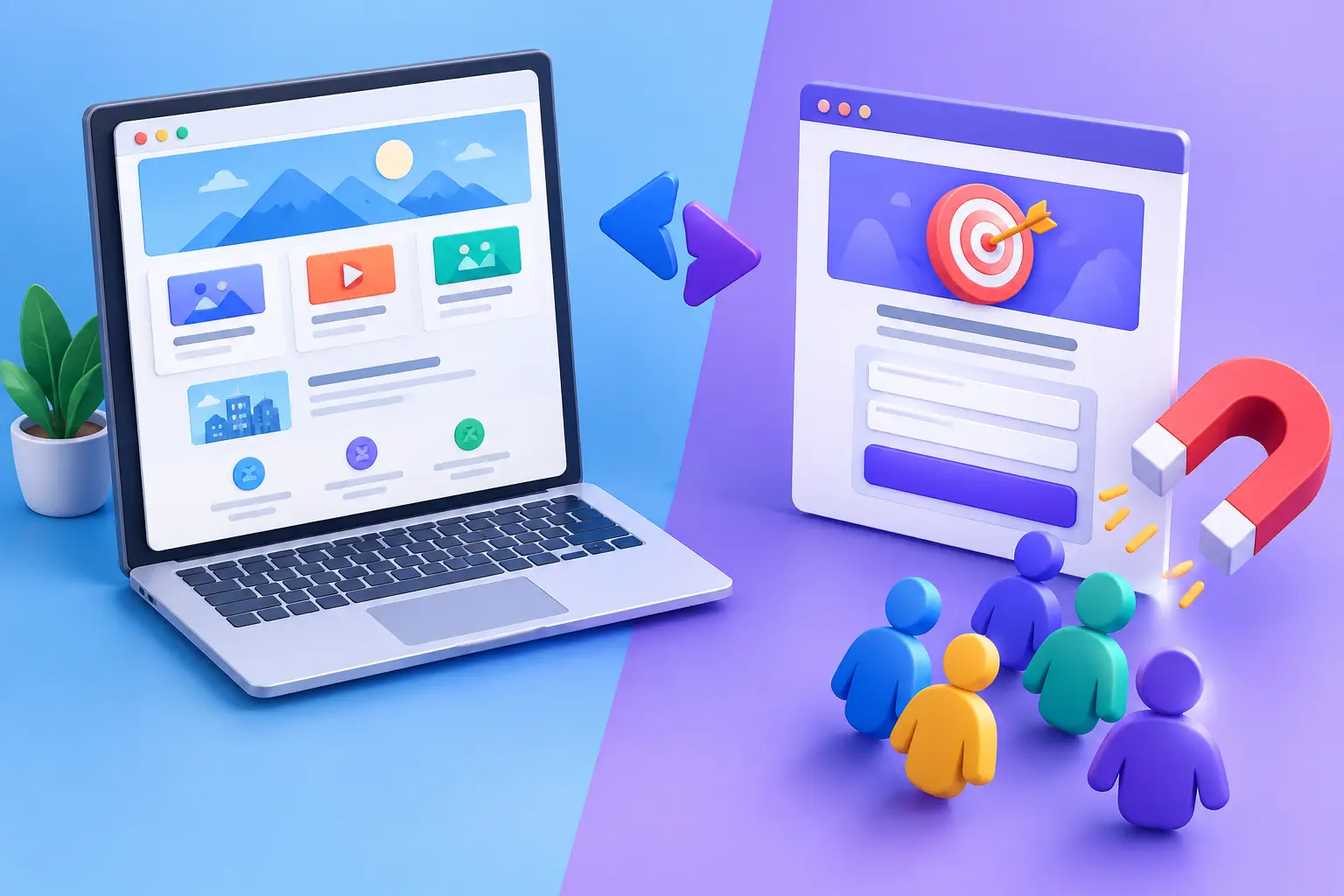
For local service businesses, both matter. The mistake is treating them as interchangeable. A website builds your long-term visibility and credibility. A landing page is built to turn a specific visitor into a call, form submission, or booking. Use the wrong one for the job and you can spend money generating traffic that never becomes a customer.
Websites versus landing pages: the core difference
A website is your business's central online presence. It gives potential customers, Google, and referral partners a complete picture of who you are, what you do, where you work, and why they should trust you. It usually includes service pages, location pages, reviews, contact details, an about page, and useful information for customers at different stages of their decision.
A landing page has a narrower job. It is a focused page designed around one offer, one audience, and one action. For example, a garage might send Google Ads traffic to a page offering a seasonal tire change. A med spa may run a promotion for a specific treatment. A roofing company may build a page for storm-damage inspections in a defined service area.
The visitor should immediately understand three things: what you offer, why it is relevant to their problem, and what to do next. There are fewer navigation choices because the page is trying to reduce distraction and increase action.
This is not a contest where one format replaces the other. A reliable lead generation system uses each where it performs best.
What a website does for a local business
Your website is the foundation for organic visibility. When someone searches for "auto repair in Barrie," "facial near me," or "Aurora furnace repair," Google needs clear pages that explain your services and locations. A single campaign page cannot do the full work of demonstrating local relevance across every service you provide.
A strong website also answers the questions that slow down a buying decision. Can you serve my area? Do you offer financing? Are you licensed or insured? What do past customers say? How quickly can I get an appointment? For higher-value services, people often visit several pages before they contact you. They are checking whether your business feels established, responsive, and easy to deal with.
That matters even when leads arrive from ads. Many people click an ad, look at the offer, then search your company name before they call. If they find an outdated site with unclear services, weak reviews, or no obvious contact path, your paid campaign loses credibility at the finish line.
A website is also an asset that compounds. Well-built service and location pages can rank over time, bringing in calls without paying for every click. It supports your Google Business Profile, review strategy, local SEO, and follow-up system. For a business that wants steady inbound demand, this is essential infrastructure.
The trade-off is focus. A website gives people options, which is useful for research but not always ideal for a visitor who is ready to act now. Too many menus, competing services, and generic calls to action can dilute a paid campaign.
When a landing page will convert better
Landing pages work best when the source and intent are specific. If you know why someone clicked, you can give them a direct next step instead of making them figure out where to go.
Consider a local HVAC company promoting same-day air conditioner repair. The ad should not send users to a general home page that mentions furnaces, maintenance plans, duct cleaning, and commercial work. Send them to a page that speaks directly to failed AC units, explains service availability, shows local reviews, and makes calling or requesting service effortless.
A high-converting landing page usually aligns its headline, offer, proof, and call to action with the campaign that brought the visitor there. If the ad says "Book Your Newmarket Brake Inspection," the landing page should continue that exact conversation. That consistency reduces hesitation.
Landing pages are especially effective for Google Ads, Meta campaigns, cold email outreach, QR codes, direct mail, and seasonal promotions. They give you a clean way to measure results. You can see which offer, message, area, or audience produces calls and bookings instead of guessing which part of a broad website did the work.
They also make testing practical. You can test a free estimate against a fixed-price offer, compare two headlines, or use different pages for Barrie and Newmarket campaigns. Those changes are much harder to isolate when every visitor lands on the same general page.
The limitation is that landing pages are not a complete digital presence. They can generate immediate responses, but they do not replace your service pages, reputation proof, or local search strategy. A landing page with no established brand behind it may struggle with cautious customers, particularly for expensive or urgent work.
Choose based on the customer journey
Start with the lead source, not your preferred design format. A person searching broadly for a provider needs a website that makes your business easy to evaluate. A person clicking a tightly targeted offer needs a landing page that makes taking action easy.
Use your website when your goal is to build local rankings, establish trust, present multiple services, support Google Business Profile traffic, or give referrals a complete view of your company. It should be fast on mobile, simple to navigate, and built around calls, forms, and bookings rather than decorative features.
Use a landing page when you are running a single campaign with a measurable outcome. This may be a seasonal offer, a new service launch, a neighbourhood promotion, a lead magnet, or a paid advertising campaign. The page should have one primary conversion goal. Asking people to call, fill out a long form, subscribe, browse services, and follow social channels all at once weakens the page.
For many businesses, the best setup is straightforward: use the website to earn visibility and trust, then use targeted landing pages to capture campaign traffic. The two should look and sound consistent, but they should not do the same job.
What makes either page generate more calls
The page type matters, but execution matters more. A beautiful page that responds slowly, hides the phone number, or makes visitors wait for an answer will still leak leads.
Start with a clear offer and an obvious call to action above the fold. For urgent services, a click-to-call option should be impossible to miss on mobile. For appointment-based businesses, keep forms short enough that people will actually complete them. Ask for what your team needs to follow up, not every detail you could possibly collect.
Next, add relevant proof. Use genuine reviews, before-and-after results where appropriate, certifications, service-area details, and plain explanations of what happens after a customer contacts you. Specific proof beats generic claims. "Serving Barrie homeowners with same-day repairs" is more useful than "quality service you can trust."
Then solve the speed-to-lead problem. A submitted form is not a booked customer. If a prospect waits until the next business day for a reply, they may have already called two competitors. Automated text acknowledgements, AI-assisted chat, call handling, and a clear follow-up process protect the marketing investment after the conversion.
This is where a disconnected setup often fails. One provider runs ads, another built the site, calls go unanswered, reviews sit on a separate platform, and no one owns the full path from click to booked job. A managed system such as Ignite Leads is designed to connect those steps so lead generation does not stop at the form submission.
Avoid the common wrong choice
Do not build a landing page just because someone said landing pages convert better. A generic page with no traffic source, no defined offer, and no follow-up plan is simply a smaller website. It will not create demand on its own.
Likewise, do not expect a homepage to carry every campaign. Sending paid traffic to a broad homepage often forces visitors to do the sorting that your marketing should have done before they arrived. If you paid to attract someone interested in one service, respect that intent with a focused path.
Also avoid copying the same landing page for every city and service while changing only a heading. Local customers can spot thin, generic content, and Google has little reason to prioritize it. Build pages around real services, real service areas, and actual customer questions.
The right page is the one that removes the next obstacle between a local customer and a booked appointment. Build the website that makes your business easy to trust, then create landing pages whenever a specific offer needs a faster route to yes.
Allan Heath
Founder of Ignite Leads. Helps local businesses grow through SEO, lead generation, and marketing automation — simplifying the playbook so owners can focus on the work.