Local SEO
The Google Business Profile Audit Checklist We Run for Every Local Client
September 18, 2026 • 10 min read
Why the audit comes before the work
Almost every local business we meet has a Google Business Profile that was set up once, years ago, and never revisited. Nothing is obviously broken — which is exactly why it goes unnoticed. Meanwhile the competitor above them in the map pack has a complete profile, active posts and reviews arriving every week.
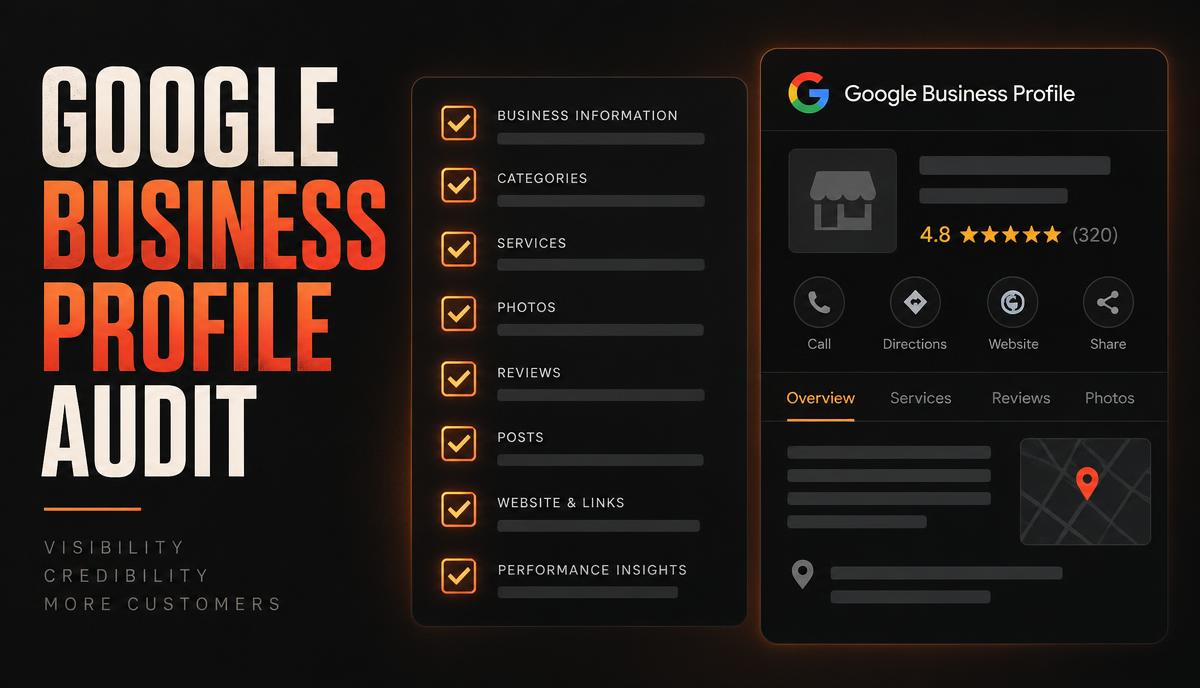
So the first thing we do is audit the listing line by line. Below is the actual checklist, in the order we work it. You can run most of it yourself in an afternoon. If you'd rather we did it, the Google Business Profile optimization page covers what that includes.
1. Ownership and listing health
- Do you have owner access — not manager access through a former agency or web designer?
- Is the listing verified, and does the verification badge still hold?
- Are there duplicate listings for the same business? Duplicates split your reviews and your ranking signals.
- Has the listing ever been suspended, and if so, was the underlying cause fixed or just appealed?
- Are there unauthorised owner changes or pending ownership requests sitting on the account?
2. Categories — the biggest single lever
More map rankings are lost here than anywhere else. A specific primary category almost always outperforms a broad one.
- Is the primary category the most specific one that describes your main service?
- What primary categories do the top three businesses in your map pack use?
- Are secondary categories used for every service you genuinely offer, and nothing else?
- Has a new, more specific category appeared in Google's list since you set yours?
3. Core business information
- Business name exactly as it appears on signage and your website — no stuffed keywords, which risks suspension.
- Address formatted consistently with how it appears elsewhere online, or hidden correctly if you're a service-area business.
- Service areas defined deliberately rather than left as a default radius.
- A local phone number, not a tracking number that appears nowhere else.
- Hours accurate, with special hours set for holidays.
- Opening date, attributes, accessibility and payment details all completed — profile completeness is a ranking input.
4. Services, products and description
This is the section almost everyone leaves empty, and it's free search engine optimization for your Google My Business listing.
- Every service listed under the name customers actually search for, each with a written description.
- Products used where they apply — they occupy real space on the listing and most competitors ignore them.
- A 750-character business description written around your services and locations, not your founding story.
- Every service in the profile backed by a matching page on your website.
5. Photos and video
- Logo and cover image set, current and correctly cropped.
- Real photos of your work, premises, team and vehicles — not stock imagery.
- New photos added at least monthly. Freshness is a signal, and dormant profiles slide.
- Customer-uploaded photos reviewed for anything misleading or out of date.
6. Reviews
After proximity, reviews are the strongest lever you control — and the one that compounds. We check volume, but also the pattern.
- Total review count against the businesses ranking above you.
- Recency: when did the last review arrive? A three-year-old 4.9 average is a warning sign, not an asset.
- Velocity: are new reviews arriving steadily, or in suspicious bursts?
- Do reviews mention your actual services by name? That language feeds relevance.
- Is every review answered, including the negative ones?
- Is there a system asking for reviews, or is it whoever remembers?
If the answer to that last one is “whoever remembers”, that's what Review Ninjas automates — requests fire the moment a job closes, and anything below five stars comes to you instead of going public.
7. Posts, Q&A and messaging
- Are posts published regularly, or has it been silent for months?
- Are the questions customers actually ask present in Q&A — and answered?
- Is messaging switched on, and does anyone reply within minutes?
- Is booking or a quote request wired into the profile where it applies?
8. Citations and NAP consistency
- Is your name, address and phone identical across major directories and industry listings?
- Are there old addresses or disconnected numbers still live somewhere?
- Do the big aggregators and your industry's specific directories have you listed at all?
9. Performance data
- What searches is the profile currently appearing for, in Google's own performance report?
- How many calls, direction requests and website clicks does it generate a month?
- How has that trended over the last year — and does it track with anything you changed?
10. Map position across the city
Finally, the part no audit should skip: where you rank from places other than your own desk. We scan a grid of postal codes for each core service, because map position changes dramatically with the searcher's location. There's a full walk-through in how to improve your Google Maps ranking.
What to do with the results
Work top to bottom. Ownership and categories first, because everything else is wasted if those are wrong. Then information completeness, then services and photos, then the review system, then citations. Prominence work — links, mentions, ongoing content — comes after the profile itself is right.
If you'd rather have the whole thing done and scored against the competitors ranking above you, we'll run it free. See local SEO services, SEO for small businesses, or book a call.
Allan Heath
Founder of Ignite Leads. Helps local businesses grow through SEO, lead generation, and marketing automation — simplifying the playbook so owners can focus on the work.